The Royal Stables
Meet the horses and see the original stable building from 1740 on a tour of the Royal Stables

Visit the Royal Stables
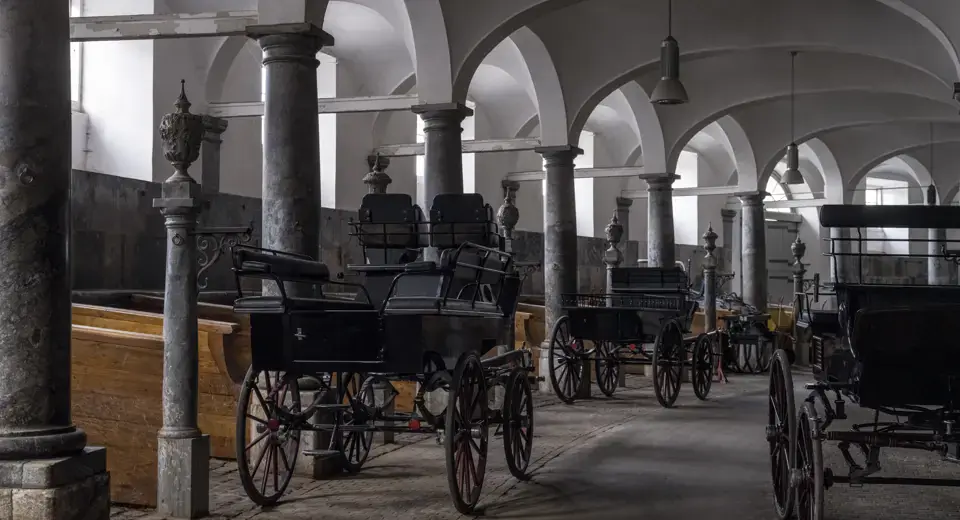
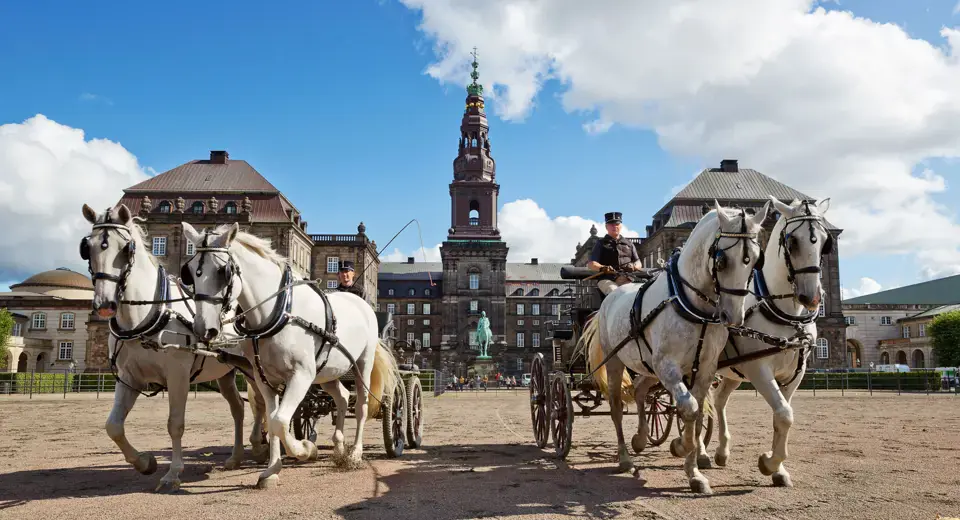
As soon as you cross the Marble Bridge, you are greeted by HM The King’s horses. Stables are an important part of a royal court, and that significance is apparent when you visit the Royal Stables at Christiansborg Palace. All year round, the sunlight creates a play of shadows across Christian VI’s arched walkways encircling the Riding Ground, and in among numerous marble columns in the stable, the white horses where royal steeds have stood since the time of Christian VI. The stable has survived two great fires and is now the only remaining part of the original Christiansborg Palace from 1740. Here you can see the harness museum, the Royal Coach Collection and, of course The King’s horse in the beautiful marble stable.
A grand setting
The 14 to 16 coach horses in the Royal Stables today are kept in a lavish building built for Christian VI’s horses in 1740. At the time, the royal household had many more horses, and up to 250 horses were kept in the stables.
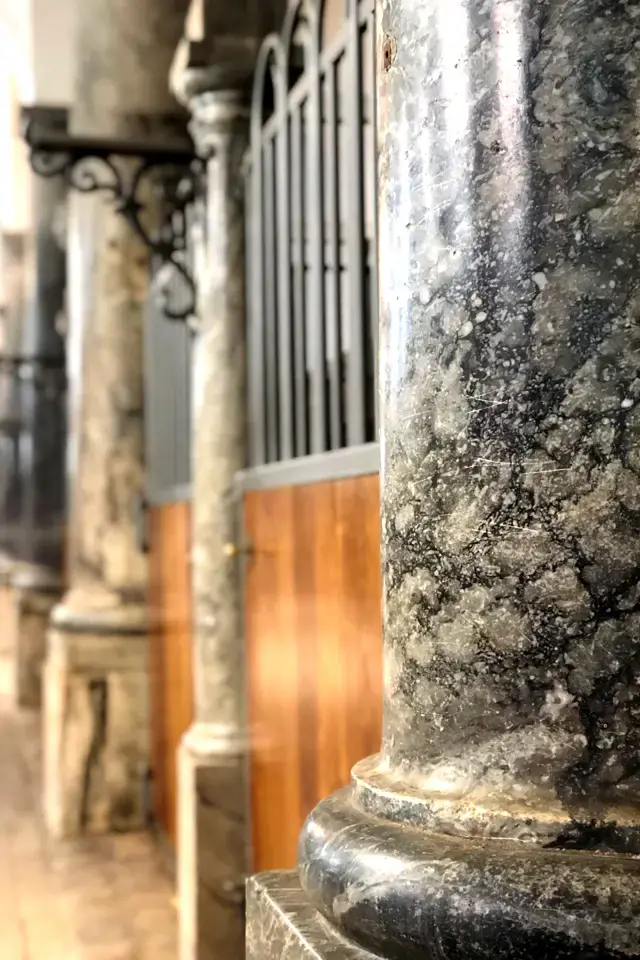
The building is known as the Marble Stable, because the horses stand among marble columns and even eat their hay from marble cribs. The precious material was not just chosen for its beauty.
Marble is also practical, because it is hard enough to sustain the kicks and scuffles that are sometimes exchanged among the horses in a stable.
The part of the stables that is still in use today has always been used for coach horses. Therefore, the central aisle and the entrances are wide enough to harness the horses inside the stable, so that the coach can be driven directly onto the Riding Ground or into the streets of Copenhagen.
Meet the white royal horses at Christiansborg Palace
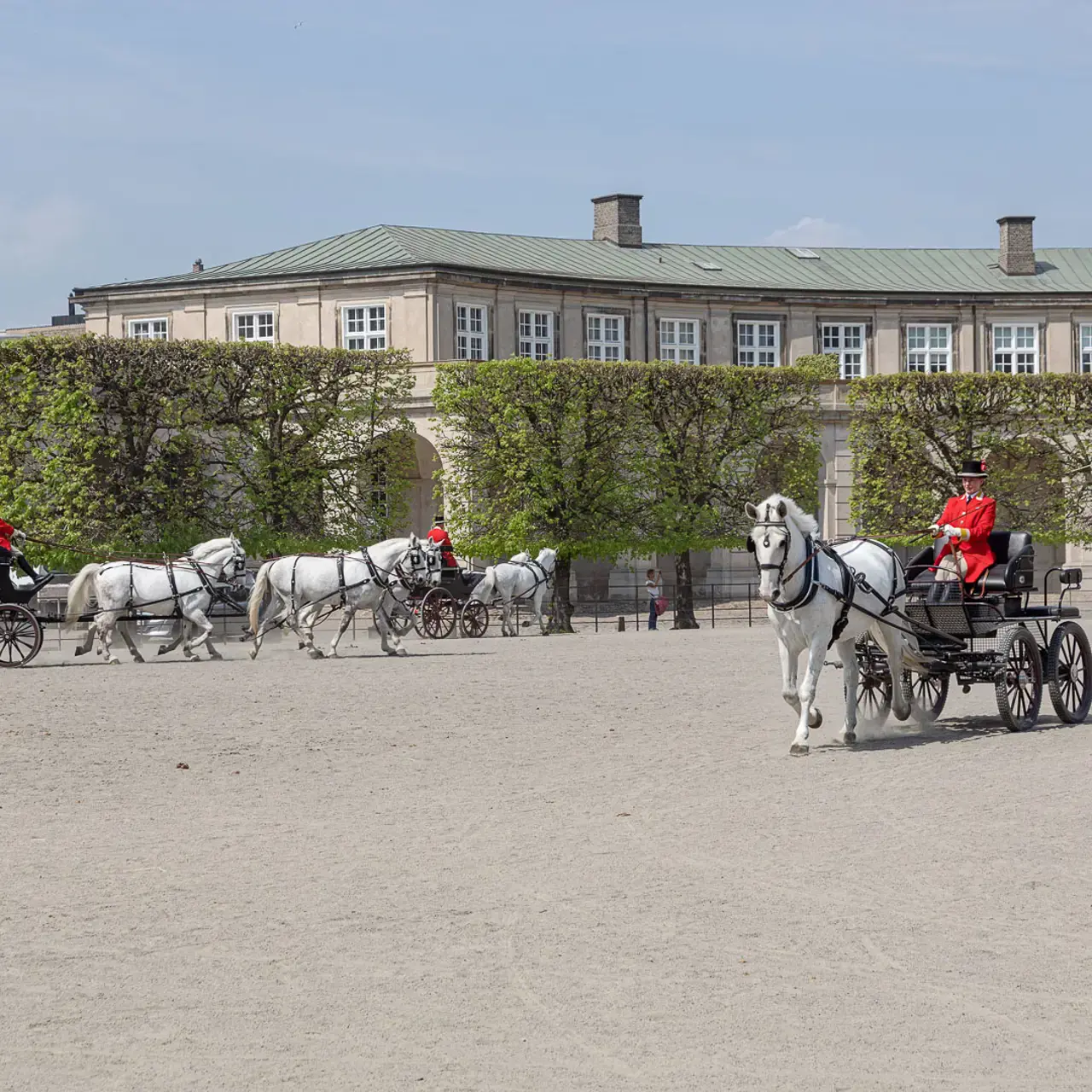
In the historical stable at Christiansborg Palace, you can meet more than a dozen white horses. They are used on special royal occasions, such as the New Year’s levee, ambassador receptions, weddings and state visits.
The horses are trained on the Riding Ground at the palace and in the streets of Copenhagen. At the riding grounds, there are also pens for the horses, and every summer, the horses go on a nice long holiday in the countryside.
Meet the horses
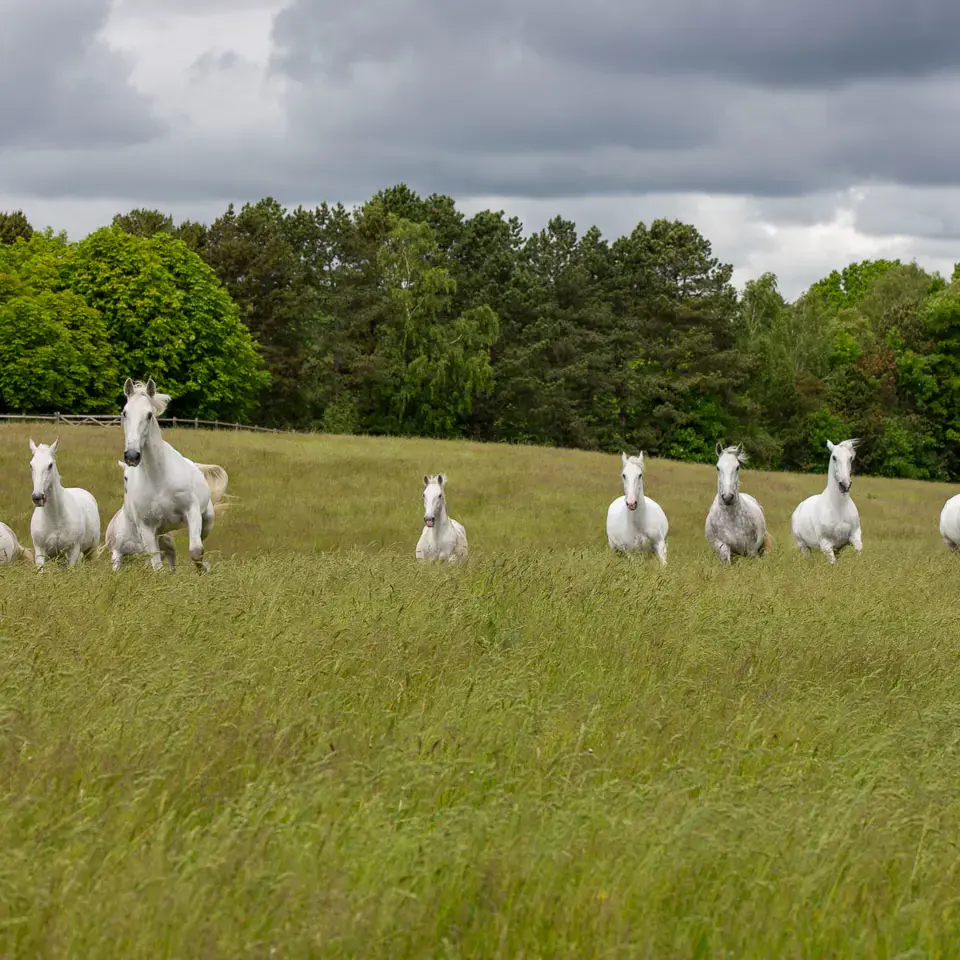
Horses on summer holiday
Photo: Jesper Clausen
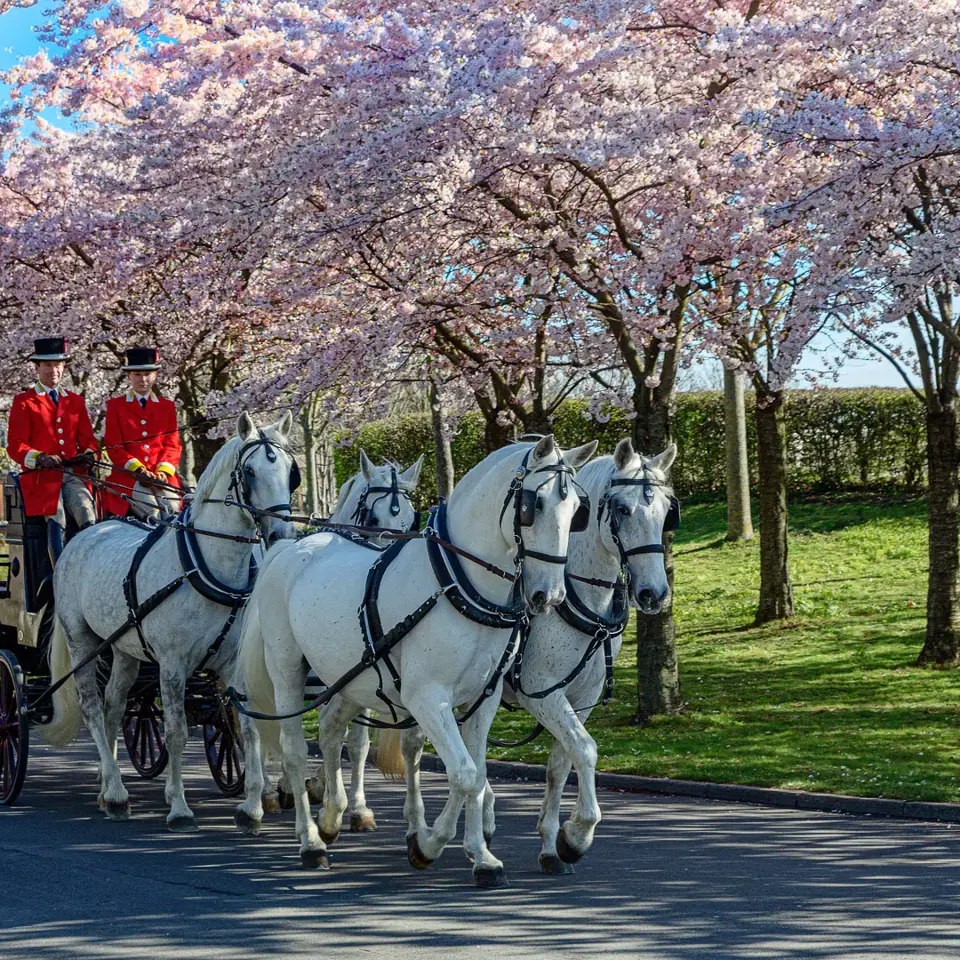
Training in Copenhagen
Photo: Jesper Clausen
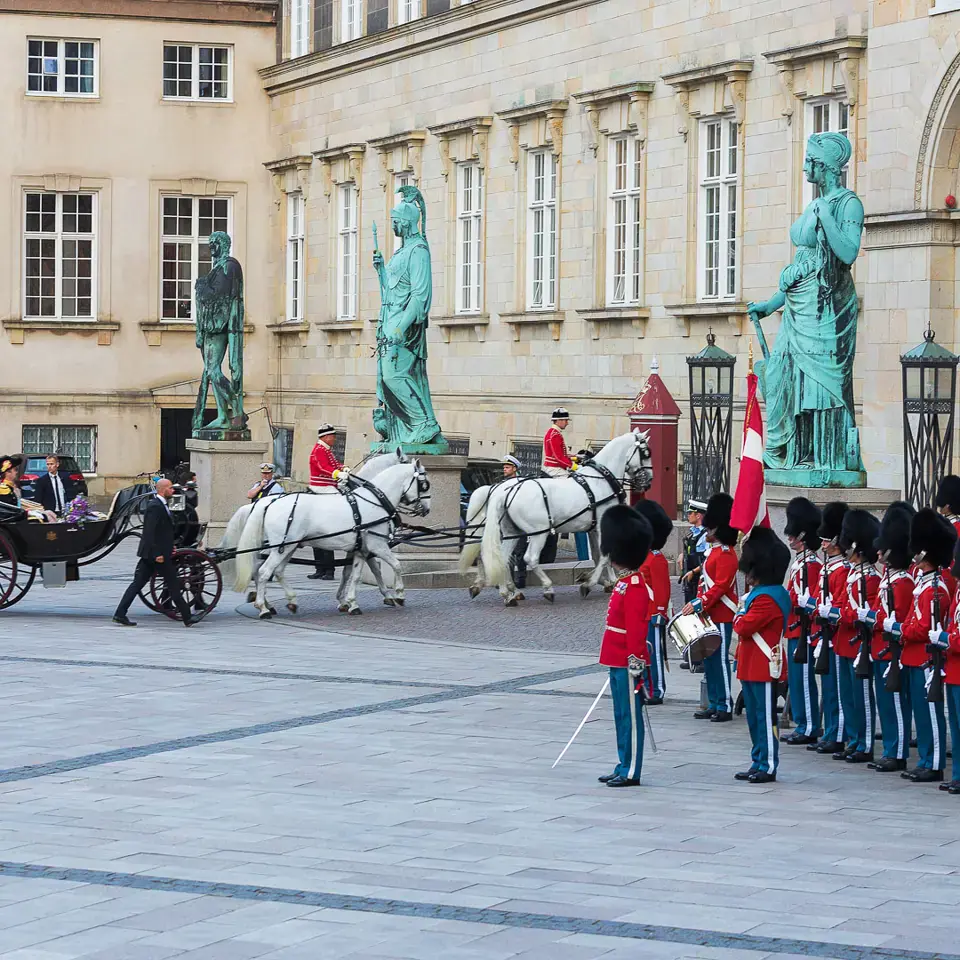
New Year’s levee at Christiansborg Palace
Photo: Jesper Clausen
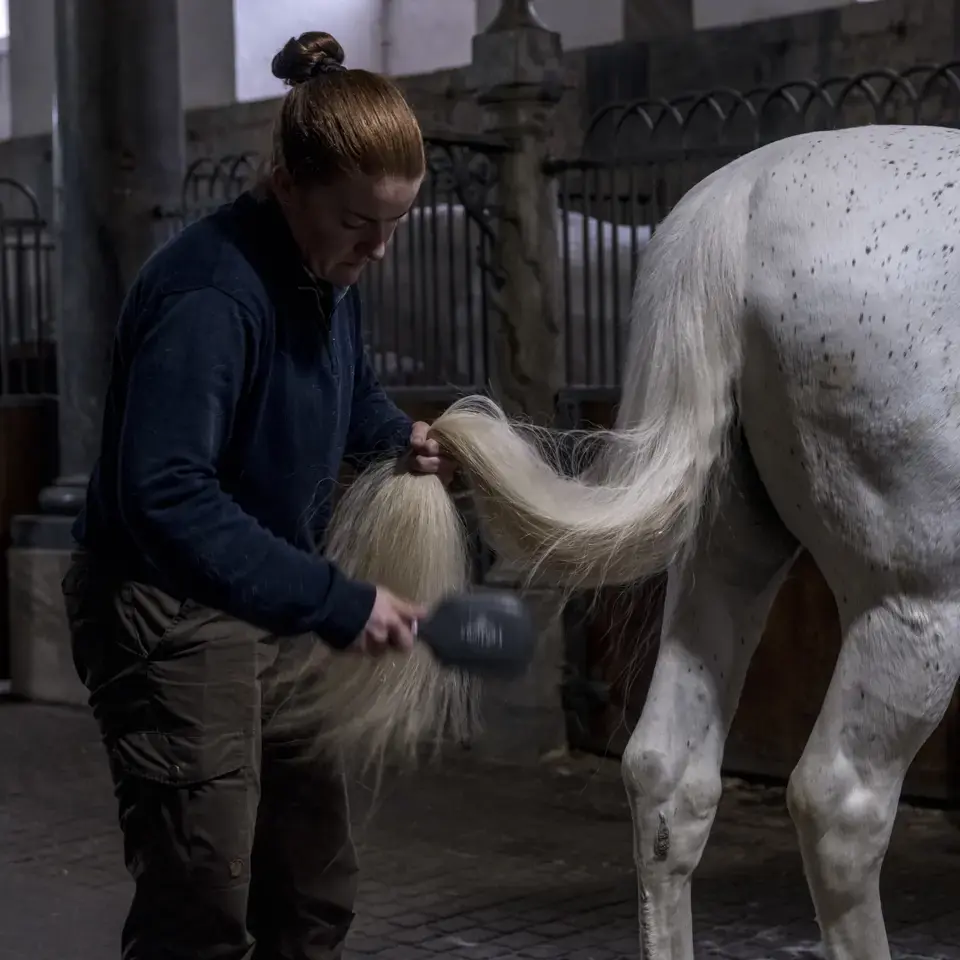
The Royal Stable Estate is responsible for tending the horses
Photo: Rasmus Hjortshøj
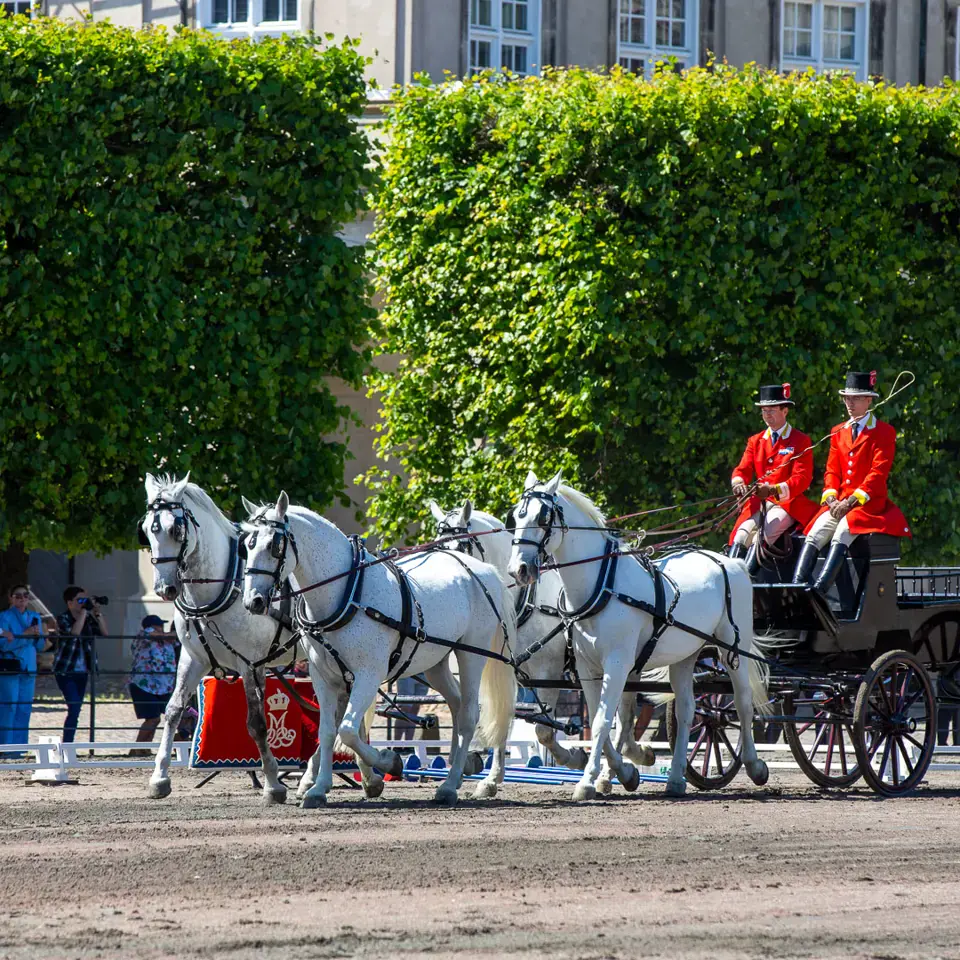
Training on the Riding Ground
Photo: Jesper Clausen
-
UNESCO’s World Heritage List
The horses at the Royal Stables originate from the historical stud farm in Kladruby. Today, the Kladruby property is a UNESCO World Heritage Site.
-
The golden age of the Frederiksborg horses
The Frederiksborg horse had its golden age in the 17th and 18th centuries. It was bred by the Royal House of Denmark for use in Denmark and abroad.
-
The reintroduction of the white horses
During the 1990s, white Kladruber horses were reintroduced in the stables.
From royal stables to World Heritage Site
Royal horses on UNESCO’s World Heritage List
The majestic and elegant horses come from the princely stud farm in Kladruby, the Czech Republic. The property has roots going back to the 16th century. Today, it is included on UNESCO’s World Heritage List.
The stud farm was established to breed coach horses for the Austro-Hungarian court in Vienna. The breed’s ancestry and history are thus closely associated with the Lipizza stud farm, which is known for supplying horses to the Spanish Riding School in Vienna.
The golden age of the Frederiksborg horses
The Royal House of Denmark previously also bred their own horses, the so-called Frederiksborg horses from Frederiksborg Castle.
The Frederiksborg horses were bred in all sorts of colours, but the finest horses - and The King's favourites – were the rare true white horses. During the mid 19th century, the royal stud farm struggled to continue the breeding programme.
The main problem may have been that demand for the baroque horse breeds was in decline in favour of more modern English breeds. Eventually, the Frederiksborg stud farm was closed.
In its heyday, during the 17th and 18th centuries, the Frederiksborg horse was very popular, also far beyond Denmark. Horses and bloodlines were widely exchanged among the royal houses of Europe. Therefore, you can find Frederiksborg horses in the bloodlines of the Kladruby and Lipizza stud farms, just as Kladrubers were also included in the bloodlines of the Frederiksborg horses.
Return of the white horses to the Royal Stables
During the 1990s, when the Royal House of Denmark wanted to reintroduce white horses, the choice fell on the dappled white horses from Kladruby, whose pedigree makes them excellent and elegant coach horses.
In the Harness Museum at the Royal Stables, you can see two of the former residents of the stables at Slotsholmen (Castle Islet): Christian V’s dappled Frederiksborg horse and Frederik VII’s true white Frederiksborg horse.
With its gold leaf and elegant design, the gold coach stands out at the Coach Museum and in the streets of Copenhagen, when it is used for special royal occasions
The finest horse-drawn coach in the Kingdom
The gold coach was first used by Christian VIII in 1840. At the time, it caused a stir because the large windows and the height of the coach provided a better view of the royals when they drove through the city streets. Like many of the other coaches in the collection, it was made by coachmaker Henry Fife, the leading supplier during the 19th century.
The collection includes a wide variety of horse-drawn carriages: dashing gala coaches that were used for the most important ceremonies and special occasions in the Royal House, but you will also find the small pony-drawn coaches that have amused generations of princes and princesses.
Traditional craftsmanship meets new technology
The Golden Wedding Anniversary Coach is one of the newest coaches in the collection. It was made by the carriage maker F. C. Schulz as a gift from the Copenhagen master artisans for Christian IX and Queen Louise for their golden wedding anniversary in 1892. It marked an elegant combination of traditional craftsmanship and new technology, as the interior of the cabin featured electric lighting. This was the coach that the Royal Couple chose to use for the carriage ride through a festively decorated Copenhagen after the public proclamation of the succession of the throne, on 14 January 2024.
The oldest coach in the collection is Queen Dowager Juliane Marie’s gala coach from the 1770s. In front of the coach is an eight-horse harness decorated with gilded silhouettes of her husband, Frederik V.
See some of the exceptional coaches in the Coach Collection here
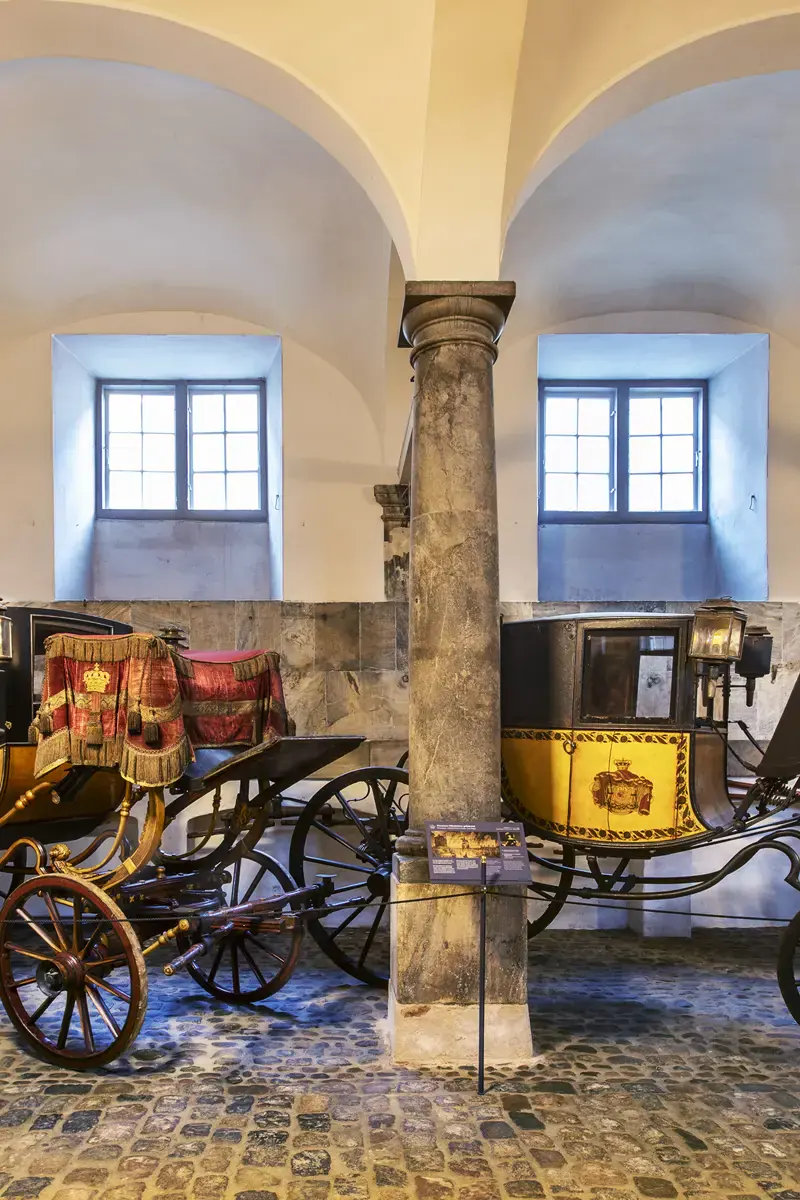
Gleaming coaches
The Gold Coach and Queen Dowager Juliane Marie’s gala coach
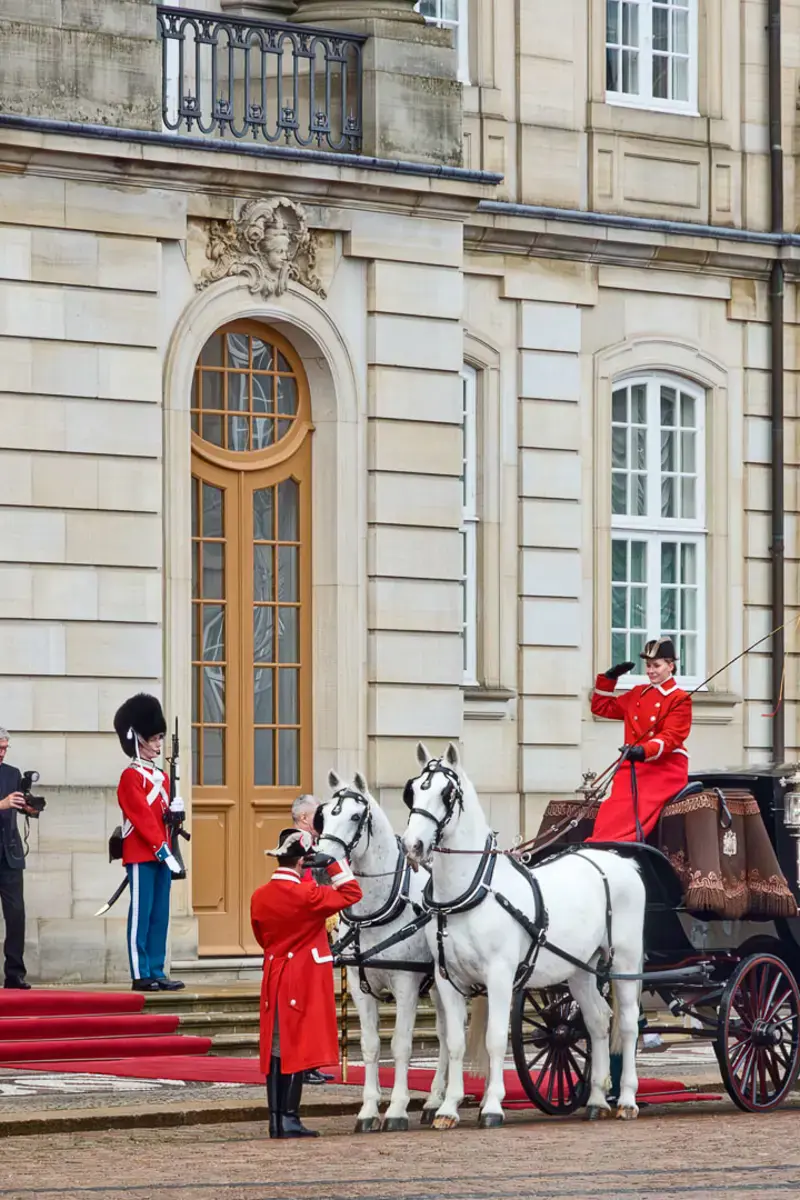
Coach driving at Amalienborg Palace
Photo: Jesper Clausen
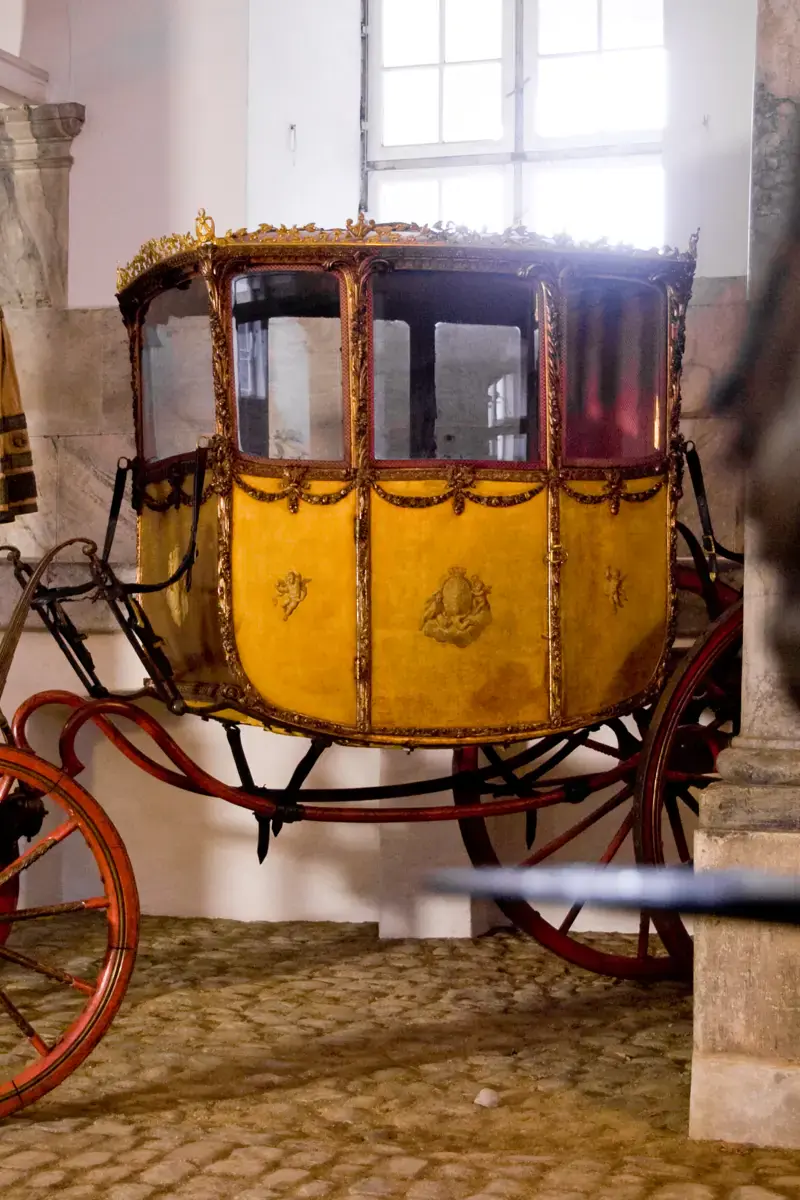
Queen Dowager Juliane Marie’s gala coach
Photo: Thomas Rahbek
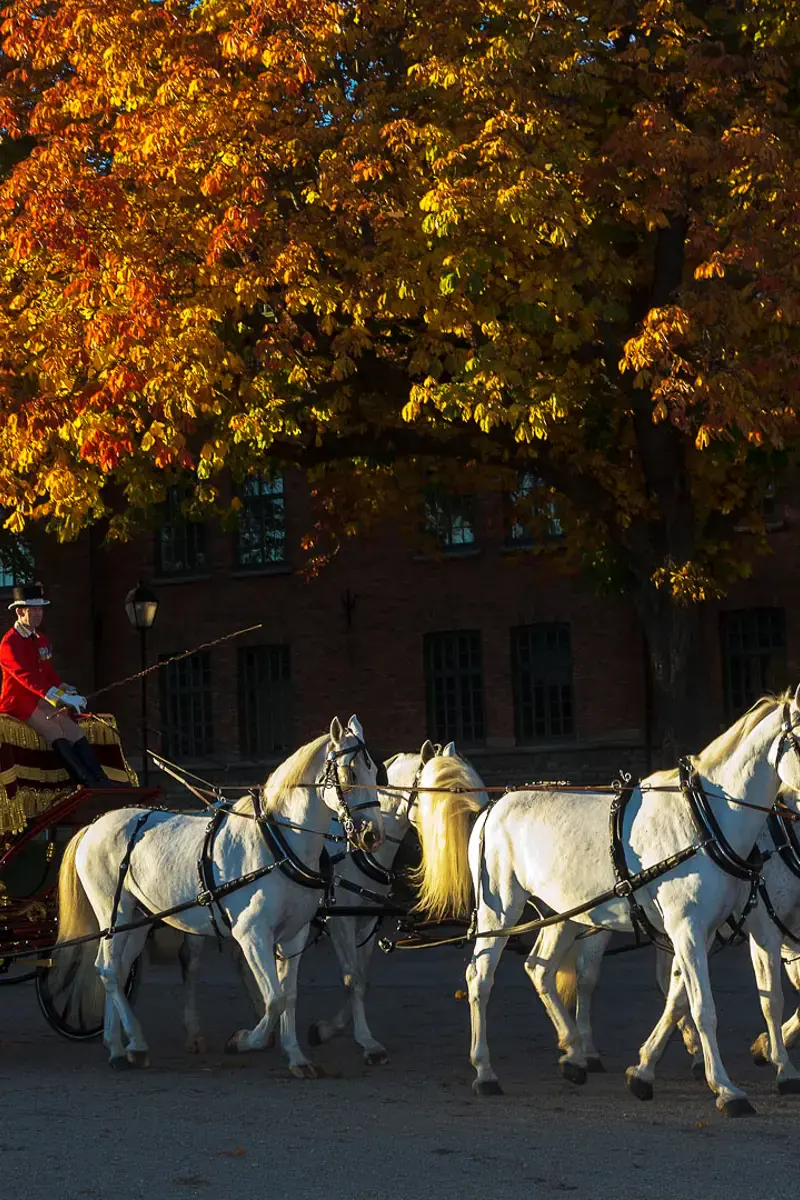
The Gold Coach gleaming in the autumn sun
Photo: Jesper Clausen
The Riding Ground complex
The royal horses get their daily training in an exceptional historical setting.
The Riding Ground complex behind the palace is the oldest preserved part of the first Christiansborg Palace. It has been the home of the royal horses ever since 1740.
The facility with the iconic arched walkways, stables and indoor riding arena encircling the large Riding Ground dates back to the 18th-century incarnation of Christiansborg Palace: a lavish palace erected between 1733 and 1745. As one of the first completed structures of the complex, the stables were inaugurated in 1740. The event was marked with a jousting tournament – a so-called carousel – in the new riding arena.
Festive celebrations for king and people
Ever since, the Riding Ground has repeatedly served as the setting of large festive celebrations, often including free food and entertainment for the people of Copenhagen.
The so-called carousel was a refined and elegant version of the medieval jousting tournament that was popular during absolutism. Spectacular carousels were often included in the large celebrations from the late 17th century to the early 19th century. Here, people could watch two teams, one of them headed by the king, compete in various feats on horseback.
Jousting lance in hand, the king could demonstrate his skill in tilting at the ring and, finally, perform ballet-like exercises on his beautiful Frederiksborg horses.
Sadly, the first Christiansborg Palace burnt down as early as 1794, but the Riding Ground complex survived both that and the next great fire, which happened in 1884. Thus, the riding complex is a unique time capsule from the largest lavish palace ever to be built on Slothsholmen (Castle Islet).
The Harness Museum
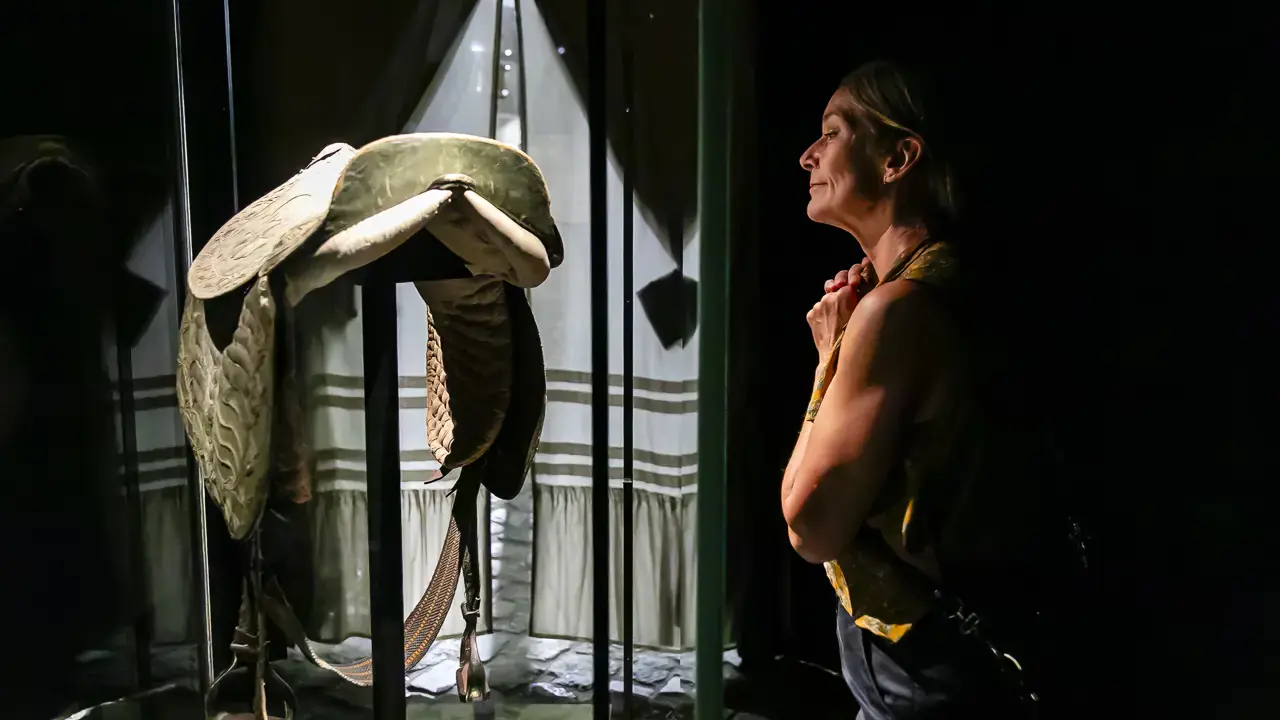
This small museum, which is a part of the Royal Stables, has a large collection of beautiful harnesses, uniforms and saddles from the history of the stables.
One of the many saddles on display used to belong to Queen Caroline Mathilde. Like The Queen, it caused quite a stir at the time. Instead of the traditional side saddle, she used a small, lightweight hunting saddle. This let her sit astride the horse and made it easier for her to keep up during the fast-paced hunts.
Pearl and the winning horse
Two stuffed horses are the first thing you see when you enter the stable collection. They are both Frederiksborg horses, a line that was once bred by the Royal House.
The dappled horse seen in mid-capriole in its display case belonged to Christian V during the late 17th century. The King was an avid horseman, who rode six horses in his riding arena on Slotsholmen (Castle Islet). The horse is said to have won a spectacular bet for The King in 1684. Maybe that is why it was preserved for posterity in this manner, which means that it now holds the record as Denmark’s oldest stuffed horse?
Next to it is a brilliant white horse, which has its own special story. Pearl, as it was called, was Frederik VII’s favourite riding horse. It was also one of the rare true white horses from the royal stud farm at Frederiksborg Castle.
Pearl came to the Royal Stables in 1848, and until The King’s death, in 1863, it was Frederik VII’s loyal favourite horse. It accompanied The King’s coffin at his funeral in 1863.