
Queen Caroline Mathilde
A tragic figure who at a young age found herself the centre of fateful events
She was born in London to the Prince and Princess of Wales. Her father died before she was born, so she was raised by her mother, far from the city and the English court.
As the youngest of nine siblings, she had a relatively free upbringing for a girl of royal birth. Thus, she never learnt to navigate the politics of a royal court, which probably left her quite unprepared for later dealing with the intrigue at the Danish court.
Arranged marriage
When Caroline Mathilde was 13 years old, negotiations began about a marriage between her and her cousin the Danish Crown Prince Christian (VII), and in October 1766, the two were married at a ‘wedding by proxy’ in London, with her brother King George III of Great Britain standing in for the groom.
At the time, Caroline Mathilde was 15 years old, and Christian was 17. Christian VII had already taken to the throne that same year, so Caroline Mathilde stepped directly into the role as Queen of Denmark and Norway when she arrived, in November, to her new country, and the couple met each other for the first time.
Lonely in Copenhagen, and Struensee joins the court
In January 1768, Caroline Mathilde gave birth to a son, Frederik (VI). Christian VII was more interested in drinking in local bars than he was in his wife, and he often ended up in brawls with Copenhagen’s night watchmen. Meanwhile, Caroline Mathilde’s straightforward and down-to-earth manners did not match the formal style of the Danish royal court, which further contributed to her sense of isolation.
When Christian VII returned from an extended trip abroad in early 1769, he brought with him a new addition to the royal court – his new physician J. F. Struensee.
In Struensee, the young queen found a like-minded soul, and it was not long, before the two became lovers. In 1771, at the age of 20, Caroline Mathilde gave birth to her second child, Louise Augusta. She was officially recognised as the daughter of Christian VII, but it is likely that Struensee was really the father.
By then, Struensee had effectively seized power from the increasingly mentally unstable Christian VII. This gave Struensee unprecedented influence but also powerful enemies.
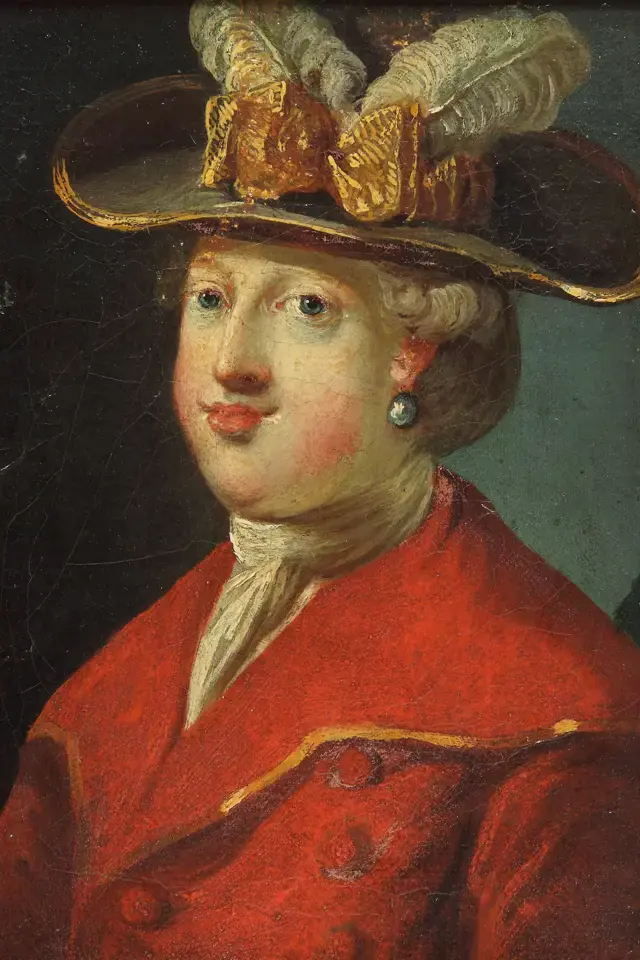

In many ways, Caroline Mathilde did not fit in at the Danish court. She enjoyed outdoor activities and went for strolls in town, apparently for exercise and to keep a trim figure.
Divorce and banishment
As Struensee’s power grew, so did dissatisfaction with his governance. As his illicit affair with The Queen gradually became public knowledge, Struensee’s political enemies plotted a coup against him and Caroline Mathilde.
After a masked ball in January 1772, Struensee was arrested. The official reason for the arrest was crimes against the crown, due to his relationship with Caroline Mathilde. Ultimately, their affair was the stated reason for the death sentence that was handed down to Struensee that September – his affair with The Queen was considered a crime against The King.
Caroline Mathilde, meanwhile, was placed under house arrest at Kronborg Castle, in Elsinore, her marriage to The King was dissolved, and she was stripped of all her titles. She also had to return the precious ring that she had received as a gift from Christian VII just after their wedding. The large brilliant-cut diamond from the ring is now incorporated into the Brillant-Cut Diamond set that is part of the Danish crown jewels.
Died suddenly
After some months in Elsinore, Caroline Mathilde was banished to Celle Castle in a principality belonging to her brother King George III of Great Britain. She had to leave behind her children, the four-year-old Frederik (VI) and Princess Louise Augusta, who was just 10 months old.
During her three-year-long exile, she was involved in plans to return to Denmark, if only to see her children again. However, she died of a severe case of scarlet fever, just 23 years old.
Caroline Mathilde was entombed in the crypt under the church in Celle, where her coffin still stands to this day.